
2027 E-commerce Trends: Integration, Personalization and Operational Scale
2027 e-ticaret trendleri konuşulurken çoğu zaman yeni arayüzler ve yapay zekâ önerileri öne çıkar. Oysa KOBİ ve üretici firmalar için büyümenin sınırı çoğu zaman daha tem...
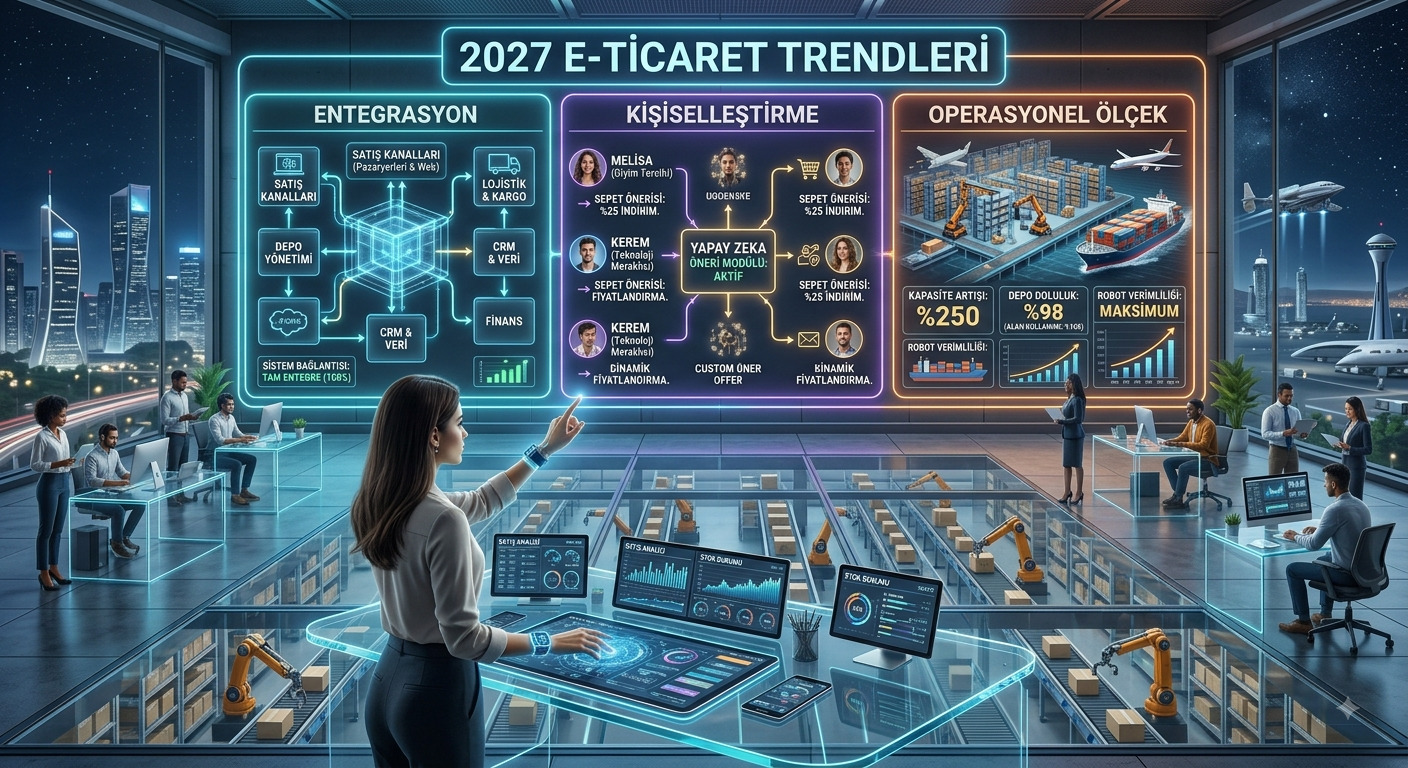
Preparing for 2027 requires making customer experience and operations part of the same design before following technology fashions.
Key Takeaways
- Customer experience cannot be designed separately from stock and order operations.
- Your own store and marketplaces can work together for different purposes.
- First-party data should be built with explicit consent and communication that offers value.
- Integration investment should first reduce data-flow errors and manual work.
- Personalization must rest on accurate data and user control.
Customer Experience and Operations Must Be Designed Together
If a product page does not give the customer accurate information, is not connected to the stock system, or the delivery time is unclear, even the most elegant design does not solve the problem. Product name, variant, size, technical specification, area of use, minimum order quantity and delivery terms are part of the purchase decision, especially for manufacturers.
SMEs should map the customer journey step by step: discovery, comparison, product selection, payment or quote, delivery, after-sales support. At each step it should be determined which system is responsible. This makes the disconnects between the website, ERP, CRM, accounting, shipping and marketplaces visible.
Payment and Delivery Expectations
At the payment screen, customers look for trust, speed and clarity. The PCI Security Standards Council defines technical and operational requirements for protecting payment card data [1]. When choosing a payment provider, businesses should examine not only the commission but also security responsibilities, error cases, the refund flow and reporting capacity.
Delivery is also a continuation of the product experience. Not selling products that are out of stock, stating the estimated time honestly, making shipment tracking accessible and writing return terms clearly all increase trust. B2B manufacturers may need a quote, lead time, staged shipment or special pricing flow instead of single orders; copying a ready-made consumer cart as is does not suit every business model.
First-Party Data and Personalization
First-party data refers to data that a business collects, with permission, from users through its own channels. Email subscriptions, purchase history, product interest or a quote request may fall under this; however, every piece of data must be processed in a way that is appropriate to its purpose, transparent and secure. KVKK (Turkey’s Personal Data Protection Law) obligations and disclosure/consent processes should be assessed with legal experts.
Personalization is not just showing a different banner to everyone. Letting a user compare technical products they viewed earlier, easily find the relevant document, or reuse their information securely when reordering is also personalization. Give users the ability to manage their preferences and opt out of communications.
How Do Marketplaces and Your Own Store Work Together?
Marketplaces can provide discovery and reach; your own store offers more control over brand storytelling, customer relationships, content and data ownership. It is possible to plan the two not as rivals but as channels that take on different roles.
However, product codes, prices, stock, images, descriptions and order status must be consistent across channels. Marketplace commissions, advertising costs, return rates and customer acquisition cost should be tracked separately. On your own store, an SEO-friendly category structure, technical product content and quote/contact flow should be strengthened.
Integration Roadmap
In the first stage, take a data inventory: Which is the product source, where is stock kept, who approves orders, which system holds customer data? In the second stage, pick the riskiest manual step. For example, if stock updates are delayed, stock integration may come first; if quote requests get lost, a CRM connection may be the priority.
In the third stage, design error messages and exception cases. Integration should manage not only successful orders but also failed payments, cancellations, returns and partial shipments. In the fourth stage, measure performance: indicators such as order processing time, stock errors, customer support requests, progression from cart to payment step and repeat purchases can be used.
Aves Dijital’s e-commerce software service page is the natural internal link for companies that want to assess project scope for custom development, WooCommerce/Magento/Shopware, and payment, stock, CRM, marketplace and analytics integrations.
Should everyone move to headless e-commerce in 2027?
No. A headless architecture can make sense for businesses that need custom experiences and flexibility across different channels; however, it creates additional cost and technical operations needs. It should be assessed together with the business model.
Is it right to leave marketplaces completely?
There is generally no single right answer. The channel mix should be built by measuring margin, customer relationship, brand goals and operational capacity.
Where should AI be used first in e-commerce?
You can start with low-risk areas such as product classification, grouping customer questions, content drafts or stock alerts. Pricing, technical suitability and legal information should remain under human control.
Related News

Metaverse Marketing Strategies: How Are Brands Establishing a Presence in Virtual Worlds?

AI Is Revolutionizing Advertising: Creativity and Data Meet in 2026

Sustainable Digital Marketing: Eco-Friendly Campaigns Are on the Rise
All News